

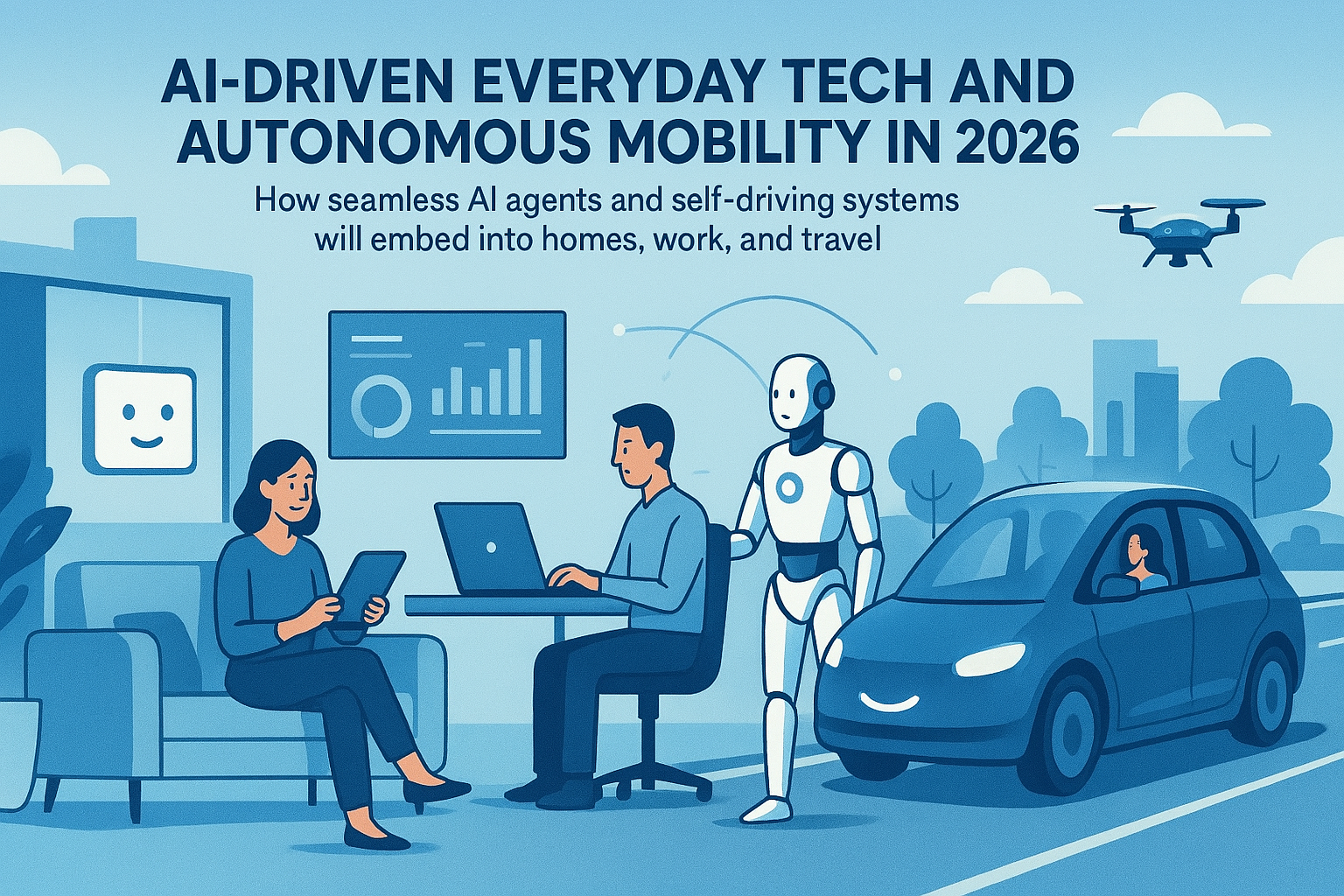
The horizon of 2026 does not merely shimmer with the promise of novelty; it vibrates with a systemic recalibration of the human experience. We are transcending the era of “tools”—those inert objects awaiting our command—and entering a period of symbiosis. The silicon veil is thinning. No longer do we simply use technology; we inhabit it, and it, in turn, inhabits the mundane crevices of our daily existence. This year marks the definitive pivot from reactive computing to proactive companionship, where the digital and the physical are stitched together by the invisible threads of advanced intelligence.
At the heart of this metamorphosis is the maturation of the AI agents. These are not the rudimentary chatbots of the early 2020s that stumbled over syntax or hallucinated with reckless abandon. By 2026, these entities have evolved into goal-oriented surrogates. They possess a persistent memory and a granular understanding of individual intent. When we speak of the tech “invading” our lives, we do not describe a hostile takeover, but a pervasive, atmospheric presence. It is an architecture of convenience so dense that to live without it would feel like a sensory deprivation.
The Dawn of the Synthetic Colleague
In the professional sphere, the concept of a “job description” has undergone a radical ontological shift. Every knowledge worker now operates as a de facto conductor of a digital orchestra. The emergence of workflow orchestration has fundamentally rewired the enterprise. In 2026, tasks are no longer manual sequences of clicking and typing; they are high-level objectives delegated to specialized systems that manage the “how” while we define the “why.”
Imagine a Monday morning. You do not begin by “checking emails.” Instead, you open your super agent dashboards, a unified command center that provides a panoptic view of your digital ecosystem. Here, a diverse array of agents—each a specialist in fields ranging from legal compliance to creative synthesis—reports on progress made while you slept. One agent has already negotiated a contract renewal based on your historical preferences, while another has stress-tested a new marketing strategy through a million simulated market permutations.
The magic lies in workflow orchestration. This is the invisible connective tissue that allows a “research agent” to find a market gap, pass that data to a “product agent” to draft a prototype, and finally alert a “logistics agent” to check supply chain feasibility—all without a single human intervention. We have moved beyond “automation” into “autonomy.” These systems do not just follow a script; they navigate the messy, non-linear realities of business with a level of nuance that was previously the exclusive domain of human intuition.
Multimodal Integration: Sensing the World
The intelligence of 2026 is no longer blind or deaf. The breakthrough of multimodal integration has granted AI a sensory apparatus that mirrors our own. In earlier years, you had to translate your world into text for the machine to understand it. Now, the machine observes the world directly. It perceives the frustration in your voice, the structural fatigue in a bridge’s sensor data, and the subtle visual cues of a changing urban landscape simultaneously.
This integration means that our interactions with technology have become “ambient.” You might walk through your home and casually mention to the air that you’re feeling a bit lethargic. The house doesn’t just turn on a light; the AI agents managing your environment synthesize data from your wearable health monitor, the current pollen count outside, and your upcoming schedule. Within seconds, the lighting shifts to a circadian-optimized hue, a nutrient-dense beverage is suggested via your smart kitchen, and your afternoon meetings are quietly rescheduled to allow for a brief restorative period.
The “invasion” is subtle. It is in the way your refrigerator uses computer vision to track the nutritional degradation of your produce and autonomously coordinates with a delivery drone to replace the wilting spinach before you even realize it’s gone. This is the beauty of multimodal integration: it collapses the distance between perception and action.
The Kinetic Intelligence: Autonomous Vehicles
Nowhere is this technological invasion more visible—or more transformative—than on our asphalt arteries. In 2026, autonomous vehicles have moved from the experimental periphery into the societal core. The steering wheel is becoming a vestigial organ, an aesthetic nod to a manual past. These are no longer just “cars”; they are mobile nodes in a vast, intelligent network.
The secret to their success in 2026 is the application of “Physical AI.” This is the convergence of high-level reasoning and low-level motor control. Modern autonomous vehicles utilize vision-language-action models to navigate environments that would have baffled the sensors of 2024. They can interpret the hesitant body language of a pedestrian or the improvised hand signals of a construction worker with startling accuracy.
The Commute as a Sanctuary
When you step into your vehicle in 2026, the interior transforms based on your intent. If you are heading to the office, the cabin becomes a satellite of your super agent dashboards. The windshield, now a high-resolution augmented reality display, highlights key data points for your upcoming presentation. Because the vehicle is part of a larger workflow orchestration network, it doesn’t just drive you; it coordinates with your office’s smart entry system, ensuring your preferred workspace is ready the moment you arrive.
Alternatively, if it is a weekend getaway, the vehicle optimizes for “mind-off” relaxation. The seats reconfigure into a lounge-like setting. The multimodal integration within the cabin tracks your eye movement and mood, curating a panoramic visual experience on the windows (which can switch from transparent to opaque displays) that complements the scenery passing by.
Comparison: 2024 vs. 2026 Tech Integration
| Feature | 2024 (Experimental/Reactive) | 2026 (Integrated/Proactive) |
| AI Interaction | Text prompts and basic voice commands. | Multimodal integration across sight, sound, and intent. |
| Daily Tasks | Manual app-switching and task management. | Workflow orchestration via autonomous AI agents. |
| Navigation | GPS-led, driver-monitored. | Autonomous vehicles with “Physical AI” reasoning. |
| Monitoring | Static dashboards for data visualization. | Super agent dashboards for real-time autonomous oversight. |
The Ethical Labyrinth
As these technologies weave themselves into our DNA, we must confront the “uncommon” dilemmas they present. We are seeing the rise of “algorithmic provenance”—the need to know exactly why an agent made a specific decision. When workflow orchestration results in a financial loss or a missed opportunity, who holds the liability? In 2026, we are developing “trust architectures” to manage this. Every action taken by an AI is logged in a transparent, auditable ledger, ensuring that even as we grant these systems more autonomy, they remain tethered to human ethics.
Moreover, the “invasion” brings a shift in human cognitive load. As AI agents take over the minutiae, what happens to our capacity for deep focus? The year 2026 is proving to be a grand experiment in “cognitive offloading.” We are becoming a species of strategists and dreamers, leaving the logistical heavy lifting to our silicon counterparts.
The Orchestrated Future
The tech of 2026 is not a collection of gadgets; it is a unified, intelligent atmosphere. It is the autonomous vehicles that glide through cities like red blood cells in a digital organism. It is the super agent dashboards that turn a single individual into a powerhouse of productivity. It is the multimodal integration that allows our world to finally “see” us.
We are living in the age of the “Super-Agent.” This is an era where the friction of existence—the forgotten appointments, the traffic jams, the tedious data entry—is being polished away by the relentless efficiency of AI agents. As we look ahead, the challenge will not be how to build more tech, but how to remain profoundly human in a world that is becoming increasingly, beautifully synthetic.