

In the theater of global industry, 2026 has emerged not as another year of flickering promises, but as the moment the house lights finally came up. We have collectively moved past the “incunabula” phase of artificial intelligence—the infancy of experimentation and fractured pilots—and entered an epoch of structural permanence. The digital scaffolding that once felt precarious is now being reinforced with the steel of organizational purpose. Technology in 2026 is no longer an elective; it is the vital viscera of the modern enterprise.
This shift represents a fundamental recalibration of the relationship between human intent and machine execution. We are witnessing the dissolution of the “tool” as a separate entity. Instead, we are seeing the rise of a networked intelligence that operates with a level of autonomy that would have seemed like alchemy a mere twenty-four months ago. To understand this transition is to understand the five tectonic shifts currently reshaping the world.
The Surrogate Epoch: Beyond Assistance
For years, the industry spoke of “copilots” and “assistants”—digital entities that waited for a nudge, a prompt, or a specific command to perform a singular task. That era is dead. In 2026, we have moved From Assistant to Surrogate. This linguistic shift mirrors a profound operational reality: AI is no longer just helping us do our jobs; it is representing us within the digital ecosystem.
A surrogate is an entity granted the agency to act on behalf of a principal. In the enterprise, this means AI agents are now vested with the authority to negotiate contracts, manage supply chain disruptions, and execute complex financial hedges without real-time human intervention. They possess “persistent agency,” a quality that allows them to maintain a goal over weeks or months, adapting their tactics as environmental variables shift.
The psychological impact of this transition is immense. When an AI moves From Assistant to Surrogate, the human role shifts from “doer” to “governor.” We are no longer the ones grinding through the spreadsheets; we are the ones defining the ethical boundaries and strategic goals within which our surrogates operate. It is a world of delegated sovereignty.
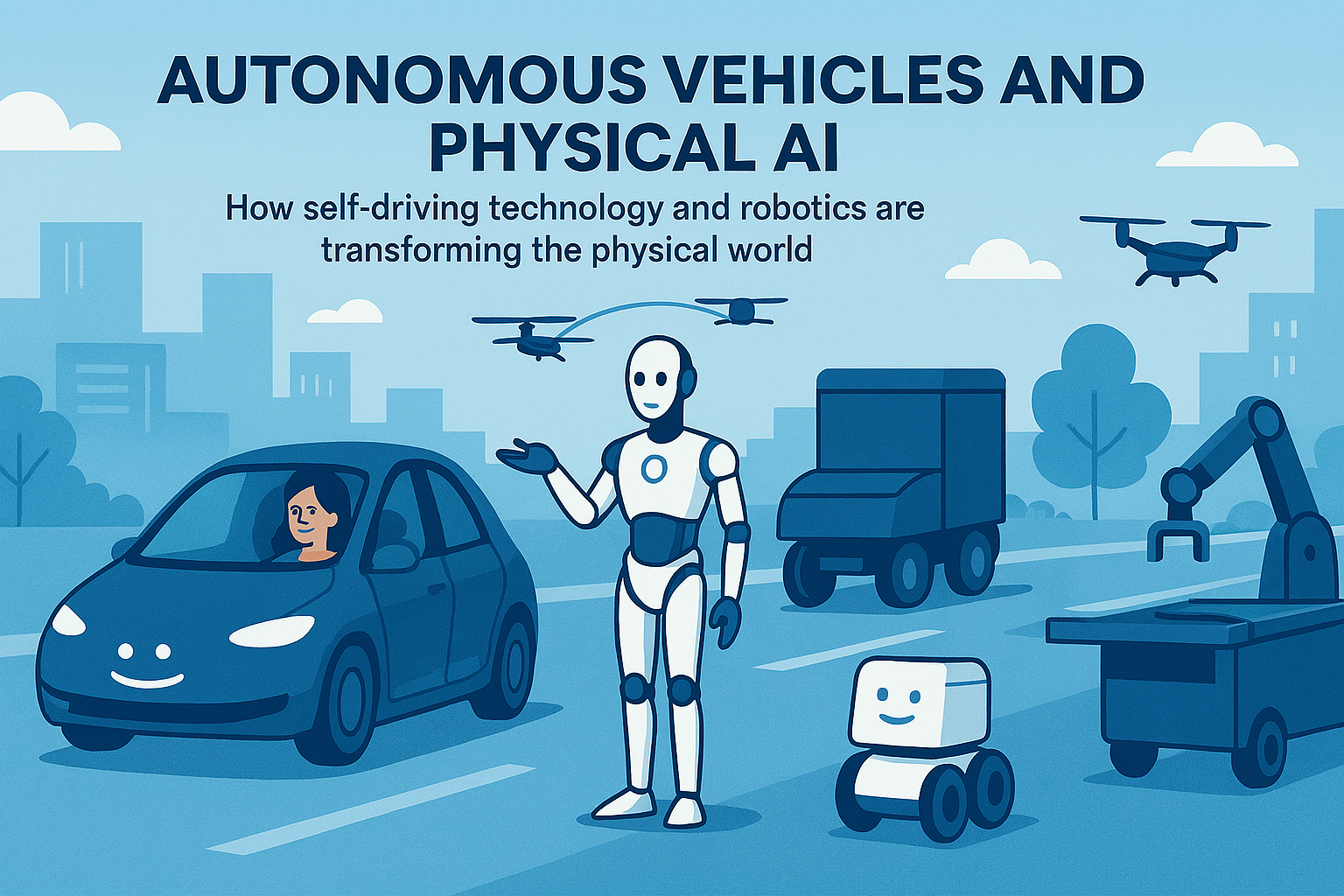
The Kinetic Shift: Autonomous Vehicles and Physical AI
While the digital world has been transformed by silicon surrogates, the physical world is undergoing its own radical metamorphosis. We are currently navigating The Kinetic Shift: Autonomous Vehicles. In 2026, the long-heralded promise of self-driving technology has finally collided with the reality of urban infrastructure.
This isn’t just about passenger cars; it’s about the “autonomization” of everything that moves. From the microscopic delivery bots that scuttle across hospital floors to the massive, electric freight haulers that move silently across transcontinental corridors, The Kinetic Shift: Autonomous Vehicles is redefining logistics. These vehicles are no longer islands of intelligence; they are interconnected nodes in a vast, fluid network.
The breakthrough that made 2026 the “Year of the Kinetic” was the perfection of “Physical AI”—models that don’t just process data but understand the physics of the world. They can predict the erratic movement of a child’s ball or the subtle shift of a wet road surface with a fidelity that surpasses human reflex. The car has evolved from a machine we drive into a service that carries us.
The Architecture of the 2026 Enterprise
| Strategic Pillar | Focus of 2024 | Reality of 2026 |
| Cognitive Agency | Reactive Chatbots | From Assistant to Surrogate |
| Physical Mobility | Pilot Programs | The Kinetic Shift: Autonomous Vehicles |
| Data Interaction | Text-Based Queries | Sensory Sovereignty |
| Operational Control | Siloed Dashboards | The Panoptic View |
| Systemic Integration | Manual API Links | The New Middleware |
Sensory Sovereignty: The End of the Blind Machine
Perhaps the most visceral shift of 2026 is the achievement of Sensory Sovereignty. For the first half of the decade, AI was largely trapped in a world of text and static images. It was a brilliant mind in a sensory-deprivation tank. Today, through “multimodal integration,” AI has claimed its own sensory apparatus.
Sensory Sovereignty refers to the ability of an AI system to ingest, interpret, and act upon a holistic stream of data—video, audio, haptics, and environmental sensors—simultaneously. An AI agent in a manufacturing plant doesn’t just read the production logs; it “hears” the slight acoustic dissonance of a bearing about to fail and “sees” the thermal blooming on a sensor array.
This is the end of the “black box” era. When technology achieves Sensory Sovereignty, it gains an intuitive understanding of context. It understands that a raised voice in a boardroom means something very different than a raised voice in a crowded stadium. This context-awareness is what allows technology to move from being “present” to being “perceptive.”
The Panoptic View: Managing the Silicon Workforce
As organizations deploy thousands of autonomous surrogates, the challenge shifts from “how do we build them?” to “how do we manage them?” Enter The Panoptic View. Inspired by the architectural concept of total visibility, The Panoptic View is the new command-and-control paradigm for the 2026 leader.
This is not a traditional dashboard. It is a live, three-dimensional representation of an organization’s entire cognitive and physical estate. Through The Panoptic View, a CEO can see the real-time health of global supply chains, the negotiation status of a thousand simultaneous contracts, and the battery levels of a fleet of autonomous drones—all in a single, intuitive interface.
It provides a level of “telemetry for the soul of the business.” In an era where work is increasingly performed by decentralized agents, The Panoptic View ensures that the organization remains a coherent whole rather than a fragmented collection of scripts. It is the ultimate tool for accountability in the age of autonomy.
The New Middleware: Orchestrating the Frictionless
At the base of all these advancements lies the most critical, yet most invisible, innovation of the year: The New Middleware. In the past, “middleware” was the clunky software that sat between databases and applications. In 2026, The New Middleware is the intelligent orchestration layer that stitches together humans, AI surrogates, and physical assets.
This is the engine of “workflow orchestration.” The New Middleware is what allows a customer’s frustrated tweet to automatically trigger a surrogate to investigate the issue, update the logistics schedule in the autonomous fleet, and notify a human manager only when a high-value decision is required. It is the connective tissue of the autonomous enterprise.
Without The New Middleware, the “invasion” of tech would be chaotic—a cacophony of competing algorithms. With it, the invasion is a symphony. It turns the “messy middle” of business processes into a streamlined, self-healing flow of value. It is the quiet revolution that makes the loud revolutions possible.
The Organizational Metamorphosis
The shift from experimentation to impact is ultimately a human one. In 2026, we are learning that technology does not “replace” us; it “re-places” us. We are being moved to a higher vantage point.
As we grant our digital counterparts Sensory Sovereignty and move From Assistant to Surrogate, we are forced to confront the “uncommon” questions of our time. What is the value of human intuition in a world of perfect data? How do we maintain our sense of agency when we are surrounded by a silicon workforce?
The year 2026 is providing the answers. We are finding that our value lies not in our ability to process information, but in our ability to define meaning. We are the conductors of the kinetic shift. We are the architects of the panoptic view. We are the ones who decide where the middleware should lead.
The tech has not just invaded our lives; it has expanded them. We are living in a world that is faster, smarter, and more responsive than ever before. But beneath the layers of The New Middleware and the hum of autonomous vehicles, the heart of the enterprise remains human.